A short comic.
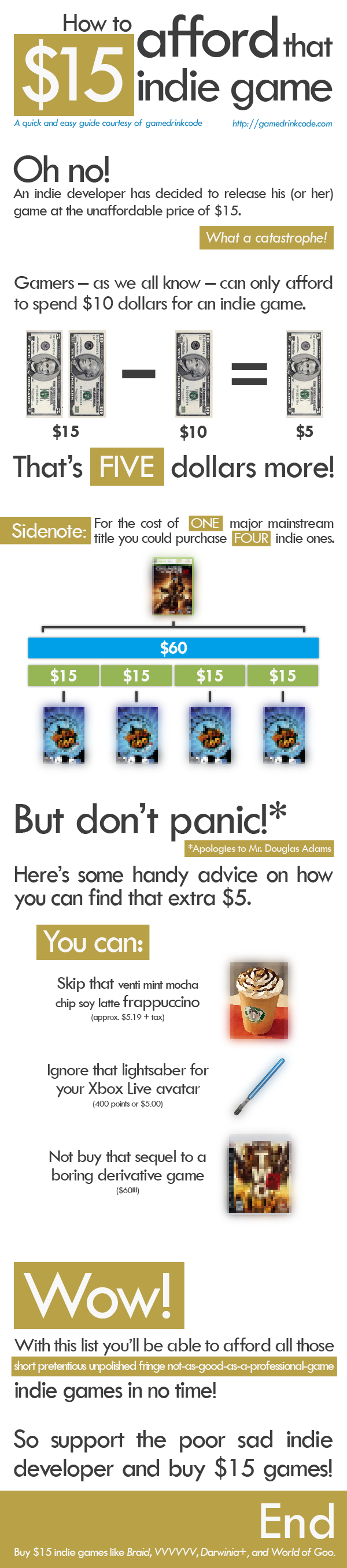
A short comic.

I agree with the demo comment. Most games that I enjoy as a demo I will buy – especially if it unlocks there and then. The price point really just sets the quality of production

Thanks for sharing these insights! Very well structured and easy to follow. Incidentally, I recently discovered AI Photo Spark — it generates professional AI headshots from selfies, no studio visit needed. Great for LinkedIn and personal branding.

Wow I think I just overdosed on bitterness and condescension.
Sorry but anyone who tries to pass this off as light-hearted or humorous is just trying to paint a thin veneer of pretty-gloss over some really, really ugly stuff.
Guess this guy just can’t imagine as possible a scenario where someone says “You know, I played your demo, and honestly I would rather go ahead and spend my $15 on three lattes than on your game.”
Starbucks may be pretentious and expensive, but they’re not the ones using shit-flinging, condescending and insulting marketing that makes me want to give my money to anybody but them.
If this is the kind of message the indie community gives out regularly to the gaming public, then it’s no wonder people are throwing their $60 at mainstream games who marketing actually makes them feel GOOD about themselves (omg shock and surprise!!), instead of like guilty losers.

People aren’t bitching because $15 will break the bank, they’re bitching because the game isn’t worth $15.
Wacky concept, I know.

Guess what? Because of this, I will never again pay for an indie game.
Way to treat your primary market with respect and grace, dick.

guess what? nobody wants your shitty money, you’re probably poor anyways.

“Guess what? Because of this, I will never again pay for an indie game.
Way to treat your primary market with respect and grace, dick.”
Guess what? You were never part of their “primary market”. An indie’s primary market is people who are mature enough to see value in something other than triangle counts and bloom.

Judging from the original blog post itself, I’d think that “maturity” is out of the question.
Anyways, I love the flamewars that have sprung up simply by people thinking that VVVVVV isn’t worth $15. It’s not. It’s been overhyped (with a painfully obvious degree of artificiality) and overpriced. Now get over it you big babies.
I’d pay $15 for any of the other games though, but I doubt that this is in response to that at all.
P.S. I agree with Fly Medical.
Oh, and one more note, LachlanL:
Guess what? Your ad hominem attacks aren’t impressing anybody. In fact, your insinuation that anyone who believes that the God-given glory which is VVVVVV is not worth three weeks pay is instantly a latte-sipping Master Chief fanboy only serves to dig yourself deeper into the grave. Voxel count > triangle count.

“Ignore that lightsaber for your XBox avatar…”
I LOLed =D
Man, some people I know, dont ever consider that $1 to $5 games in XBLIG, but BUYs these virtual clothes Crap… =(

Rocketbirds has more production value, and it’s $5 cheaper.
Sure, it’s a ripoff of flashback, but at least it’ll last longer than a shower.
VVVVVV is OK, just overrated to no end because it’s something slightly different.
Ohh hi, “Eyebrows”. I wasn’t replying to you, but since you’ve decided to jump down my throat for some reason, I guess I should respond (this is the internet after all and one must defend one’s e-penis).
First of all, I didn’t mention VVVVVV. I had to google it the other day to find out what it was. Not my cup to tea, but it looks like some people are enjoying it. Apparently though, I must be that game’s mother or something because you’ve decided that I love it to bits and have landed here, flaming and insinuating to defend it. The world is an amazing place when it is filled with assumptions, eh?

This is the most sarcastic and smug thing I’ve read on the Internet. Congratulations, you’re the most annoying person on StumbleUpon so far today! I’m only about 100 Stumbles in, however, so you’re title is up for grabs. 🙁

Your comic makes me want to pirate indie.

I think this post is plainly ridiculous. I’m not one for indie games (prepare for gross generalisations), I find them very monotonous and after the demo couldn’t even dream of buying the full game 99% of the time.
However, there are many things that indie developers could do to make me personally more inclined to buy their game.
-Make buying it easy
-Don’t make me replay the demo, and make me aware that i wont have to
-Make it a price that isn’t comparable to an album, or a tv series, make it such that i can thing “oh, its only £8, i could spend that on a meal” rather than “oh man £12?! that’s alot”
This comic has almost entirely ruined any purchase from an indie developer in the future. Kudos.
p.s. Big budget game series are not boring and derivative simply because they have a back story, that’s worth considering for your games.

lol most indie games suck and are hardly ever worth more than 5 bucks much less 15.

Awesome! 😀

I think this post wasn’t necessarily about the fact that you should spend 15$ on indie games. Let’s be honest…If there’s actual innovation, not rewriting an old concept, it’s coming from the indie zone. of course, some games are innovative, some not so much. I, for one, wouldn’t spend more than 25$ on a game. except if the game was really worth it.
People need to recognize the true value of the indie scene. sure, some games aren’t worth their price. totally true. some games are better than others. but even this is a subjective point of view. Being indie is about trying stuff that hasn’t been tried before, stuff that you would like to see. You may or may not like it.
Indie games are a mirror into the vision of the developer. but indie devs deserve money, because they go to big lengths to do something that they want to see done, even if it’s not the most awesome game ever made. They’ve got courage to try a new concept. You’ll almost never see a big company risk everything to bring out a game that might be a total failure, just because they want to innovate.
In my opinion, every game dev has the obligation of innovating in his life.
In conclusion, support indie games. support innovation.

WAAAH SOMEONE INSULTED GRAND THEFT AUTO WAAAAH
I hATE YOU YOU SUCK

But, but, if it’s available on the Internet, it should always be free, just like music albums and blu-ray movie rips. Right?

thats all good, except most indie games that i have found on xblive suck because they are short and the quality of indie games fall short to mainstream produced games and latte frappaccinos. I might pay $3 for an indie game.

Quite right! Software is a pain to develop – at least software that is rightfully called software. A decent remuneration is ok!

For me, I’ve been scavenging on sales, though/and in cases of “donation” or “name your price”, I try to get around a dollar. I’m a cheap ass, and likely not an aid to the developers, at the least in name-your-price deals. However, I’d imagine that putting such games on sale is not so much about turning profit, but exposing not only the games but also the developers. After the steam (lulz) runs out on a game’s release, its worth to the developer than takes on an advertisement role. “Hey, you remember that game you liked? Those guys are making another one!” By selling them on their previous work, even at such a loss, they might get their purchase on the new venture. I know that I wouldn’t’ve gotten World of Goo, or even Portal, because I didn’t have an interest that offset the price. But I’ve been enjoying (and getting appropriately mad at) WoG, and now that I’ve had first-hand time with Portal, I have some basis for interest in playing Portal 2, especially since a good friend liekz it.
tl;dr – For games I wouldn’t have bought anyway, offering them at broke-rate prices is good exposure.
(Although, I likely won’t buy anything, no matter price decency. I’m just that cheap, aside from my pre-order swag addiction (I’m trying to break it) and brand-loyalties to SQEX.)

I’m sorry but VVVVVV is just plain shit.
You people need to understand is that indie game industry is full of crap too. There are just a few gems.

Hey there, You’ve done a fantastic job. I’ll certainly digg it and personally suggest to my friends. I am confident they will be benefited from this web site.

Even years later this makes sense. Supporting indie devs is vital. Their creativity is truly priceless.

Fun to see 2010 debates. 15 dollars was such a big deal then. The indie market changed so much.

The comic’s point about demos directly influencing purchase decisions is spot on. That’s a practical reminder of how a good trial can convert interest into a sale. For a different kind of puzzle, you might enjoy testing your logic with this 24 game solver.
The comic’s point about players treating a $15 indie game as a major purchase while dropping that same amount on coffee without a second thought really stuck with me. It’s a practical reality check on how we mentally value different expenses, even when the dollar amount is identical. For anyone who found that trade-off interesting, you might also appreciate the discussion about demo strategies and pricing psychology in the comments below.

Great breakdown. The detail you highlighted is something I keep running into while building multi-panel comic tools — the consistency-across-frames trade-off you describe is one of the hardest unsolved layers in the whole pipeline. Bookmarking for reference.

Love the practical examples. They make a big difference in understanding.

The comic’s advice on waiting for demos resonated with me, though I still struggle with the impulse to buy full-price titles. Since I run a site called Sprinki Sbrunga where I experiment with rhythm game mods and sound layering, I often find myself distracted by audio mechanics while trying to budget for games.

The point about demos acting as instant triggers for purchases really stood out to me. I actually run a lighthearted site called Sophia Watson where expecting parents use traditional Chinese and Mayan charts to playfully guess their baby’s gender based on their birth and conception dates, and reading your breakdown definitely gave me some fresh ideas on how to frame our little guessing tools to feel more like exciting baby shower activities than straightforward surveys.

This piece on “How to afford an indie game” was easy to follow, especially where it keeps the main idea clear for readers. faymas prompt is also handy when organizing game notes and quick checks.

I don’t usually drop more than $20 on a game, but when I saw that the indie devs behind Iron Nest actually released a multiplayer patch on schedule and didn’t just ghost the community, I felt like I had to show support beyond the purchase price — it’s exactly that kind of low-key accountability that makes the indie scene worth the price tag for me. That willingness to ship something experimental and then stick around to fix it is rare even among big studios. — Iron Nest Guide multiplayer page

I appreciate the discussion on indie game pricing and value—it’s a tough balance for developers, but focusing on unique concepts like clever mechanics and personality can make a big difference, even if the production value isn’t AAA-level.

I’ve burned more hours on this puzzle than I’d like to admit, and the beauty is that every session feels fresh—the tile-merge logic stays simple, but the decision-making gets brutally tight once you pass 1024. What surprises me most is how the game subtly teaches strategy: corner anchoring, keeping the largest tile pinned, and resisting the urge to chase random high numbers. It’s a perfect mental reset for anyone who enjoys abstract challenges without needing a manual. For those who want to test alternate rule sets or daily variations, readers can explore a handy collection via our 2048—it’s a solid way to compare different board dynamics without hunting across separate sites. I’d recommend starting with the classic mode and then trying a smaller grid if you’re craving a quicker, more chaotic round.

This is a great breakdown of why some games just hook you instantly while others feel like a chore. The balance between challenge and reward is so delicate, and it’s fascinating how small tweaks in pacing or feedback can make or break the experience. I’ve personally found that the best sessions happen when the difficulty curve feels almost invisible, guiding you forward without ever feeling unfair. For those looking to dive deeper into what makes certain titles stand out from the crowd, readers can use our gamedayer.com to see a curated selection that puts these principles into practice. It’s one thing to analyze the theory, but seeing how different developers execute it really brings the whole concept into focus.

This is a clever approach for anyone tired of wrestling with tangled cables or spotty connections. Having a dedicated, stable network for your smart devices really does change the daily experience, especially when you’re streaming or running a busy home office. I’ve seen people set up separate access points for guest use and their own gear, which keeps things both fast and secure. If you’re curious about the practical side of setting this up, readers can check out our posterwifi for a straightforward breakdown of the options. It’s one of those upgrades you don’t realize you needed until the lag disappears.

Tarot isn’t about predicting a fixed fate—it’s more like holding a mirror to your own patterns and choices. I’ve found that pulling a daily card works best when I pair it with a specific question, like “What energy should I release today?” rather than asking for a yes or no. The real power shows up when you track those pulls over a few weeks; you start noticing recurring themes that your conscious mind tends to gloss over. If you’re curious about structuring that kind of reflective habit, our Tarot Bitio walks through simple layouts and journaling prompts that turn a casual shuffle into a meaningful ritual. It’s less about mystical certainty and more about building a consistent dialogue with your intuition.
Leave a Reply